Mild dementia
Older adults who struggle with meals, personal hygiene, and avoiding everyday accidents like a stove left on.
Vesper is an in-home appliance that watches over and gently guides people with cognitive disabilities through everyday life — without sending a single byte to the cloud.
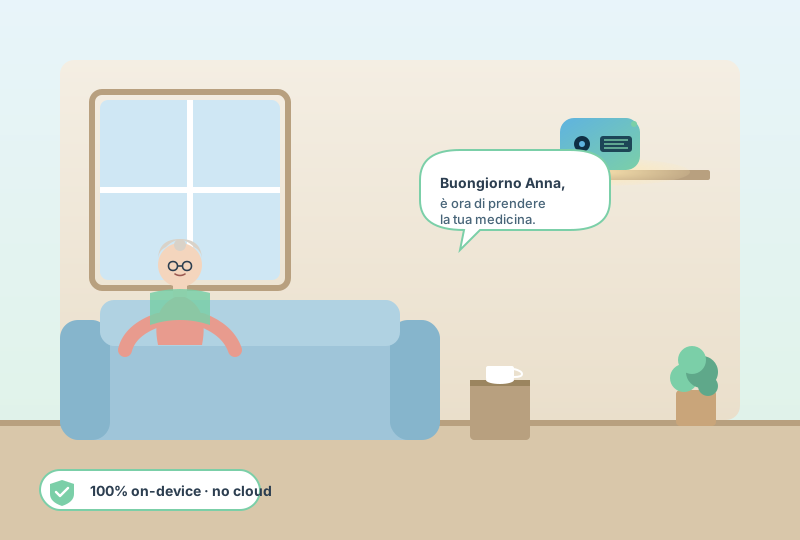
Every day they face real difficulties handling daily routines at home. Their families carry a heavy load, often with the constant worry that something will go wrong when they're not there.
Older adults who struggle with meals, personal hygiene, and avoiding everyday accidents like a stove left on.
People on the autism spectrum (high and medium functioning) who need structure, predictable routines, and steady contextual support.
Adults with severe ADHD on the executive function side: planning difficulties, time management, sticking to daily routines.
Those who live alone and need a discreet kind of watch: accident detection, missed medication, isolation.
The solutions that exist today are not enough: passive video surveillance that records but never intervenes, or generic voice assistants never designed for cognitive fragility. Vesper was built to fill that gap.
Vesper is a hardware appliance — cameras, microphone, speakers — guided by an AI that understands the home context and talks to the person living there.
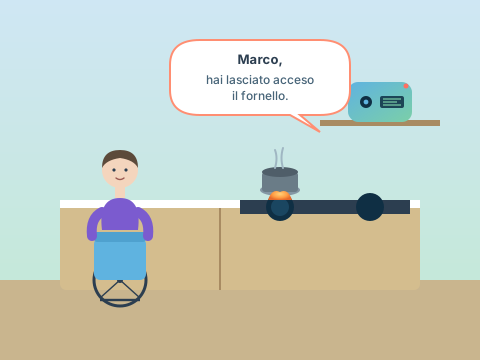
The system automatically picks up critical events: stoves or appliances left on, unusually long stays in the bathroom or kitchen, potentially unsafe behaviour. When it notices something, it speaks up immediately with a personalised voice prompt.
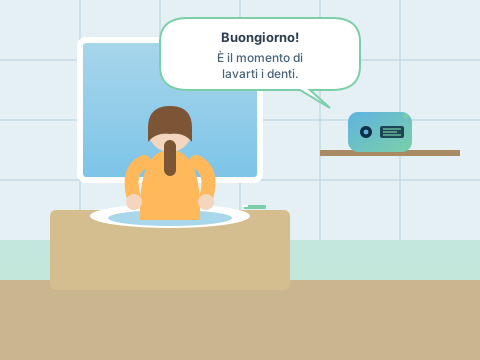
Vesper talks in simple sentences, tuned to the user's profile and the time of day. Tone, frequency, and wording adapt over time based on how the person responds.
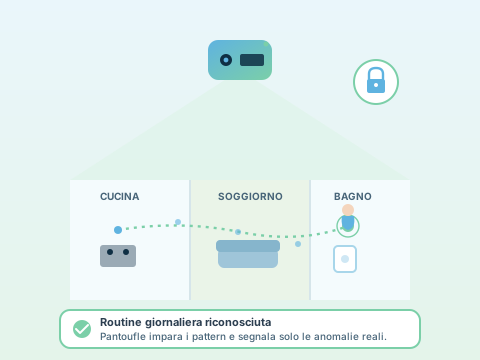
The AI watches the daily routine and learns the person's usual patterns. It flags only the meaningful deviations — no constant false alarms. A companion app lets family members receive notifications and, if needed, switch on optional modules.
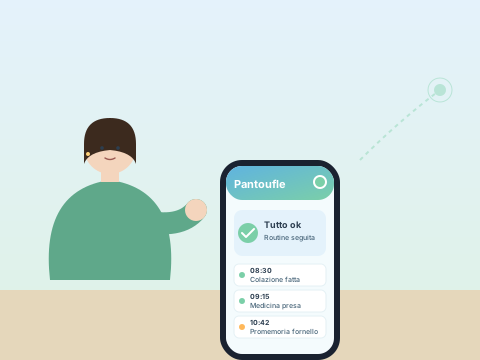
A dedicated mobile app is included. You see the day's status at a glance, receive priority notifications, and — optionally — switch on extra modules like event recording or extended supervision, always with the user's explicit consent.
All analysis happens on the device. No video or audio ever leaves the home. No cloud, no streaming, no "convenient remote access" — because the person living in the home deserves their privacy, even more so when they're fragile.
Vesper is not on sale yet, and before we finish it we want to hear from the people who provide care every day. Five minutes, no commitment: we never ask for the name of the person you care for, or for diagnoses, or for documents.
Vesper wasn't born from market research. It was born from the everyday experience of a family that lives the same challenges as the people we want to serve. The technology works. The need is real.
Tell us about your situation: we'll figure out together whether Vesper can help. No commitment, no sales script.
No. By default it doesn't record anything. Analysis is in real time, on the device, and the raw data isn't stored. Recording is an optional add-on, switched on only with explicit consent.
No. All AI processing happens on the device. There are no video or audio streams going to external servers. The device isn't even reachable remotely, except for the add-on modules you explicitly switch on.
No, Vesper is positioned as a non-medical device. It doesn't diagnose, doesn't monitor vital signs, doesn't replace a doctor. It's an assistive tool, accessible via the public funding routes for assistive technology.
Professional in-home installation usually takes half a day. It covers placing the appliance, setting up the personal profile, and a hand-over session with the family.
Yes. All the AI runs on-device, so the core functions don't depend on the connection. The internet is only used for caregiver-app notifications and software updates.
Yes. Vesper's non-medical positioning makes it eligible for the contributions provided by Italian Law 104/92 and the assistive-technology benefits, without the bureaucratic burden of MDR-certified medical devices.
We're starting a pilot phase with 10 selected families in Milan and Rome in 2026. If you'd like to take part in the pilot, write to us through the form: pricing is reduced for participants.